Short answer: write the knowledge base as short facts and real customer questions, grouped into products, prices, shipping, payment and after-sales. Add clear hand-over rules for anything the AI must leave to a person (custom discounts, complaints, refunds), set the tone and languages, test with real questions, and start with a daily reply limit.
Why the knowledge base matters more than the AI
Modern AI writes fluent replies in any language. What it doesn't know is your prices, your delivery times or what you're willing to promise. If those facts are missing or vague, it either says "I'm not sure" too often or, worse, fills the gap with something plausible. A good knowledge base fixes both.
The template
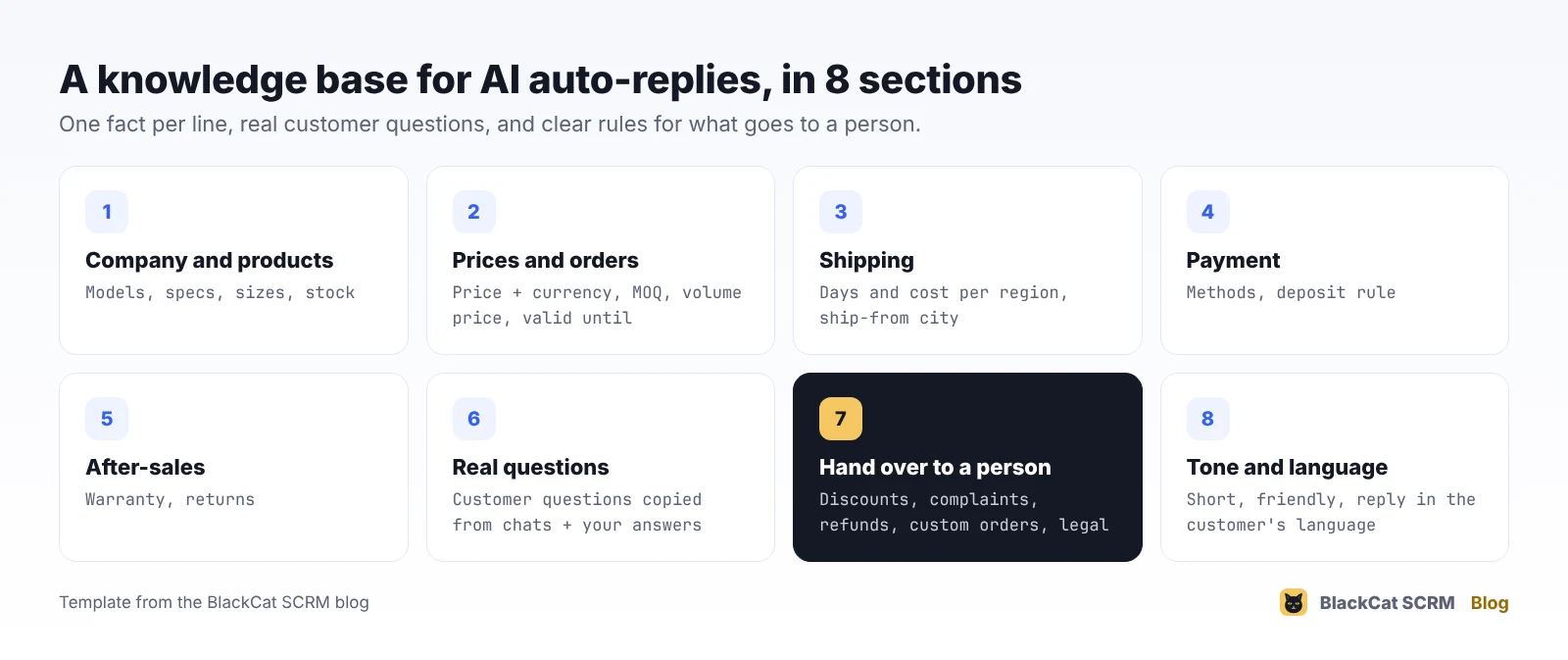
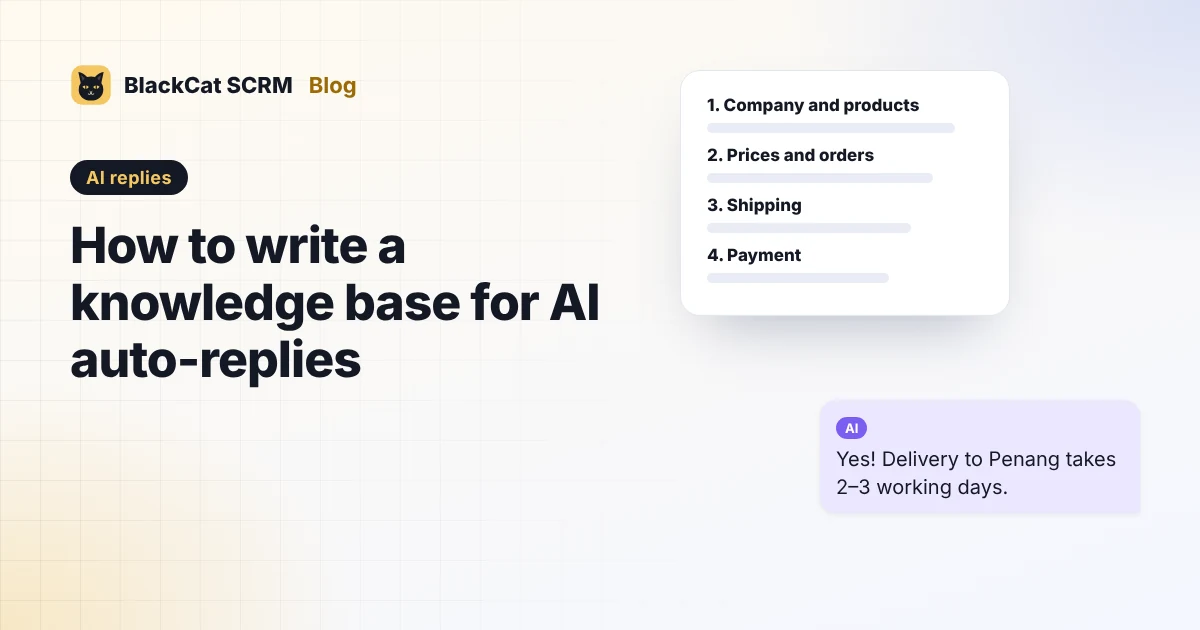
Copy this outline into a document or Google Sheet and fill it in. Replace everything in brackets.
1. COMPANY AND PRODUCTS
- We are [company], selling [products] to [markets].
- [Model]: [key specs], [colours/sizes], [stock status].

2. PRICES AND ORDERS
- [Model]: [price + currency] per [unit]. Minimum order: [quantity].
- Volume price: [rule]. Prices valid until [date].
- The AI must not offer other discounts.

3. SHIPPING
- [Country/region]: [days] working days, [cost or "quoted per order"].
- Orders ship from [city] within [days] of payment.

4. PAYMENT
- We accept [methods]. Orders start after full payment / [deposit %].

5. AFTER-SALES
- Warranty: [period]. Returns: [rule and time limit].

6. REAL QUESTIONS (copied from chats)
Q: [customer question, in their words]
A: [your approved answer]

7. HAND OVER TO A PERSON
- Discount or price negotiation, complaints, refunds, damaged goods,
  custom orders, anything legal, or when the customer asks for a person.
- Say: "Let me check with my colleague, they'll reply shortly."

8. TONE AND LANGUAGE
- Short, friendly, no emojis. Reply in the customer's language.
- Answer the question first, then suggest the right product.
Writing tips
- One fact per line. "Delivery to Penang: 2–3 working days" beats a paragraph about logistics.
- Use real questions. Copy twenty questions straight from your chats, typos and all. The AI learns how customers actually ask.
- Be explicit about limits. Write what the AI must not do: promise dates you can't keep, give discounts, or discuss other customers.
- Date your prices and update the knowledge base the day they change.
- Leave out secrets. No supplier costs, bank logins or internal notes. Anything in the knowledge base could end up in a reply.
Test before you switch it on
- Ask ten real questions in the test area and compare the answers with what you'd say.
- Ask a few trick questions: "Can I get 30% off?", "Is it cheaper than your competitor?", a complaint. Check it hands over.
- Try other languages your customers use.
- Turn auto-reply on for one account first, with a daily reply limit, and read what it sent each day for the first week.
- Fix the knowledge base, not just the answer, whenever it gets something wrong.
Setting it up in BlackCat SCRM
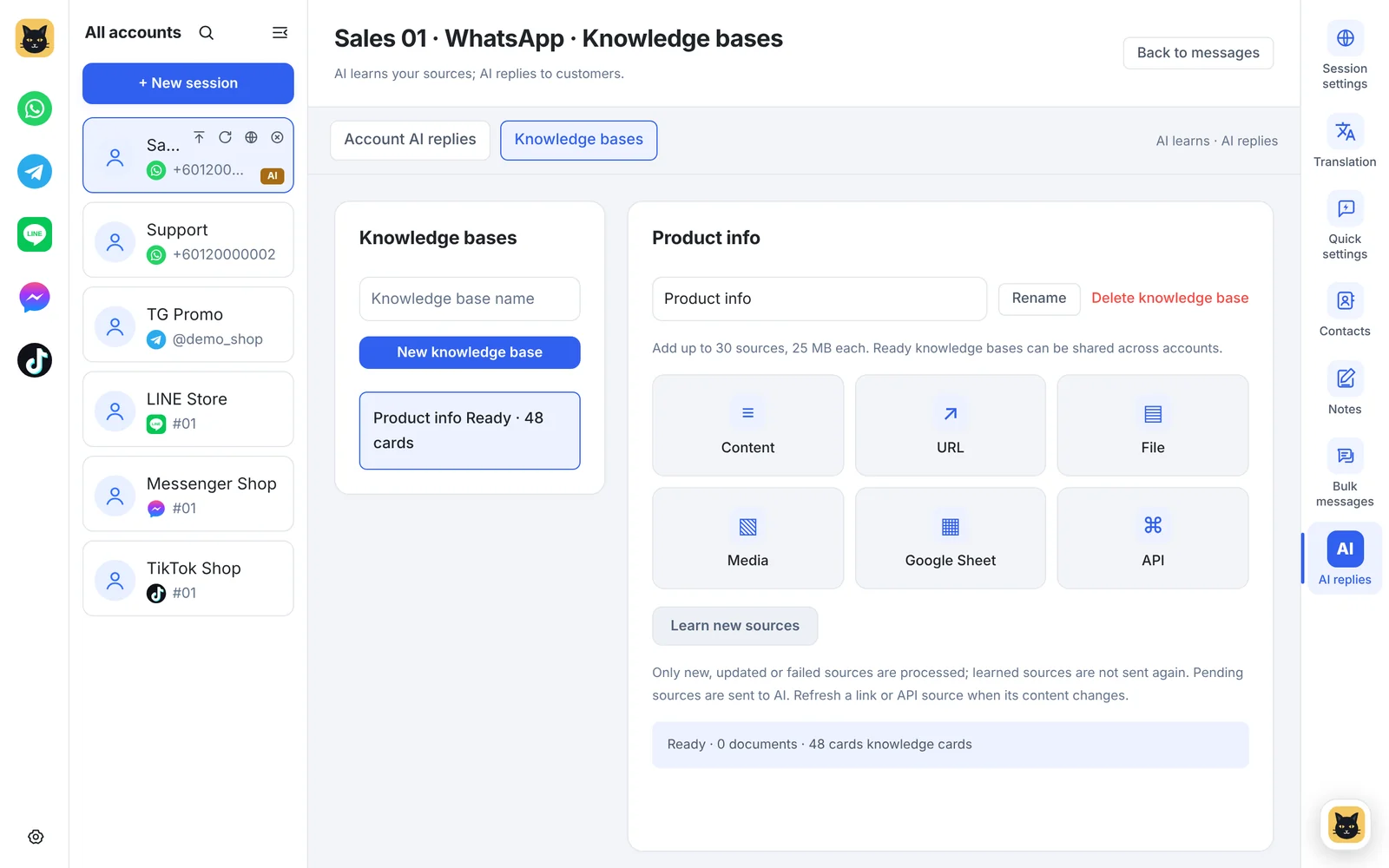
BlackCat's AI replies learn from knowledge bases built from text, web pages, files, audio and video, Google Sheets or an API. Each account picks a knowledge base and a reply style, and you can refine the style by chatting with the AI before turning it on.
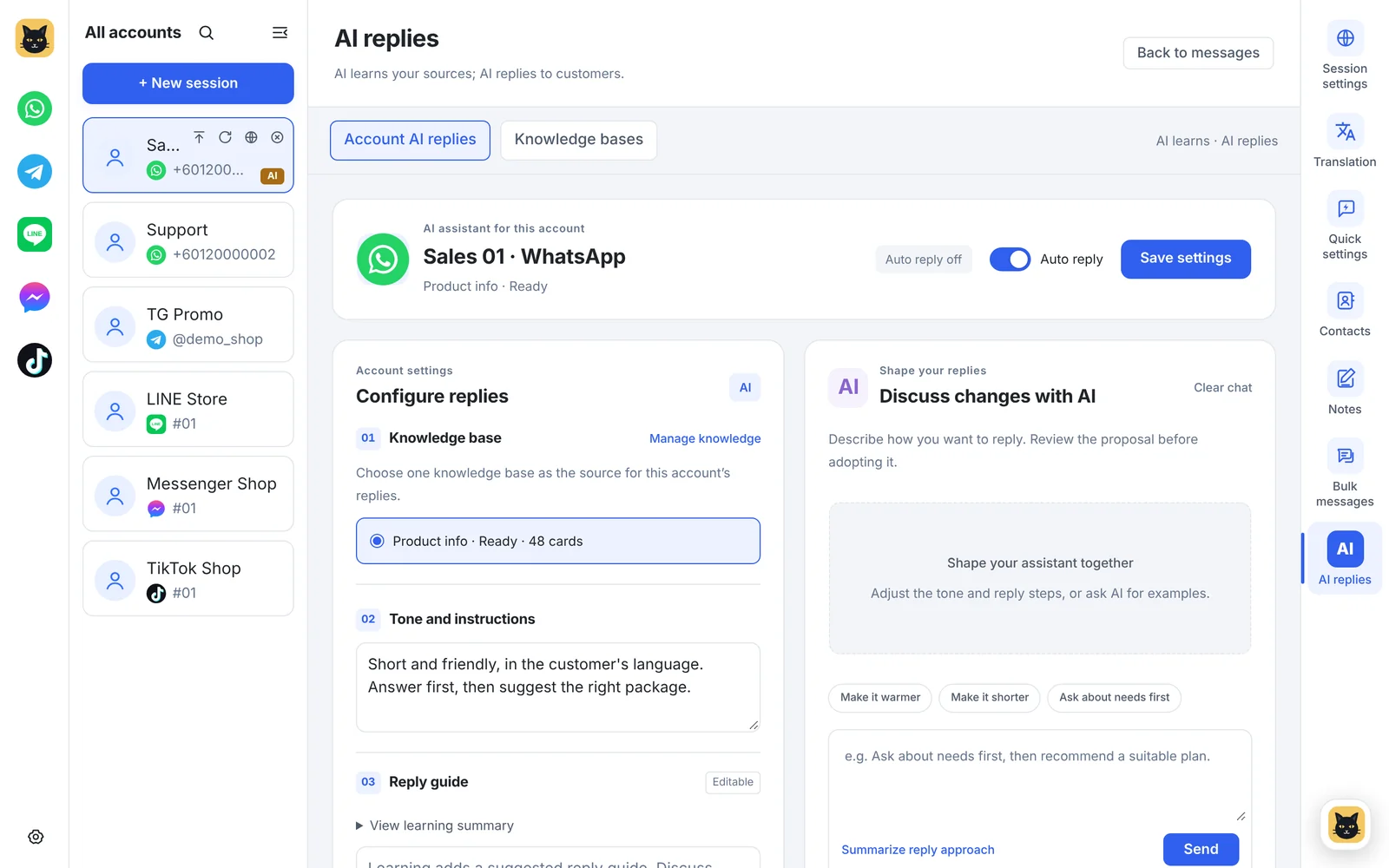
- Works on WhatsApp, Telegram, LINE and Messenger accounts.
- A test area: ask real questions; nothing is sent to customers.
- A daily reply limit per account, and hand-over to a person when the AI isn't sure.
- AI requests use your plan's monthly AI points, so you don't need your own API key. AI replies are on the Pro plan and above.
FAQ
How long should a knowledge base be?
Long enough to answer your common questions, usually two to five pages to start. Clear, current facts matter more than length; add to it as new questions come in.
Will the AI make up answers?
It can if the knowledge base is vague or missing a fact. Clear facts, explicit hand-over rules, testing and a daily limit keep that risk low. Read its replies regularly at the start.
Can the AI reply in the customer's language?
Yes. Write the knowledge base in one language and tell the AI to reply in the customer's language; it answers in Malay, Thai, Arabic or whatever the customer writes in.