Short answer: the Gulf week isn't yours. Saudi Arabia, Qatar, Kuwait, Bahrain and Oman work Sunday to Thursday with a Friday–Saturday weekend; the UAE has worked Monday to Friday since 2022, with government offices closing at Friday noon. The UAE is four hours behind Malaysia and Saudi Arabia five, so their afternoons are your evenings. Monday to Thursday are the days everyone works. Plan around Ramadan, expected to start around 8 February 2027, when working hours are usually shorter. Answer in the language the buyer writes in, which is often English; if it's Arabic, keep prices as numerals with a currency code and check the translation before sending. BlackCat SCRM translates Arabic both ways and can answer common questions with AI replies while your office is closed.
When do buyers in the Gulf work?
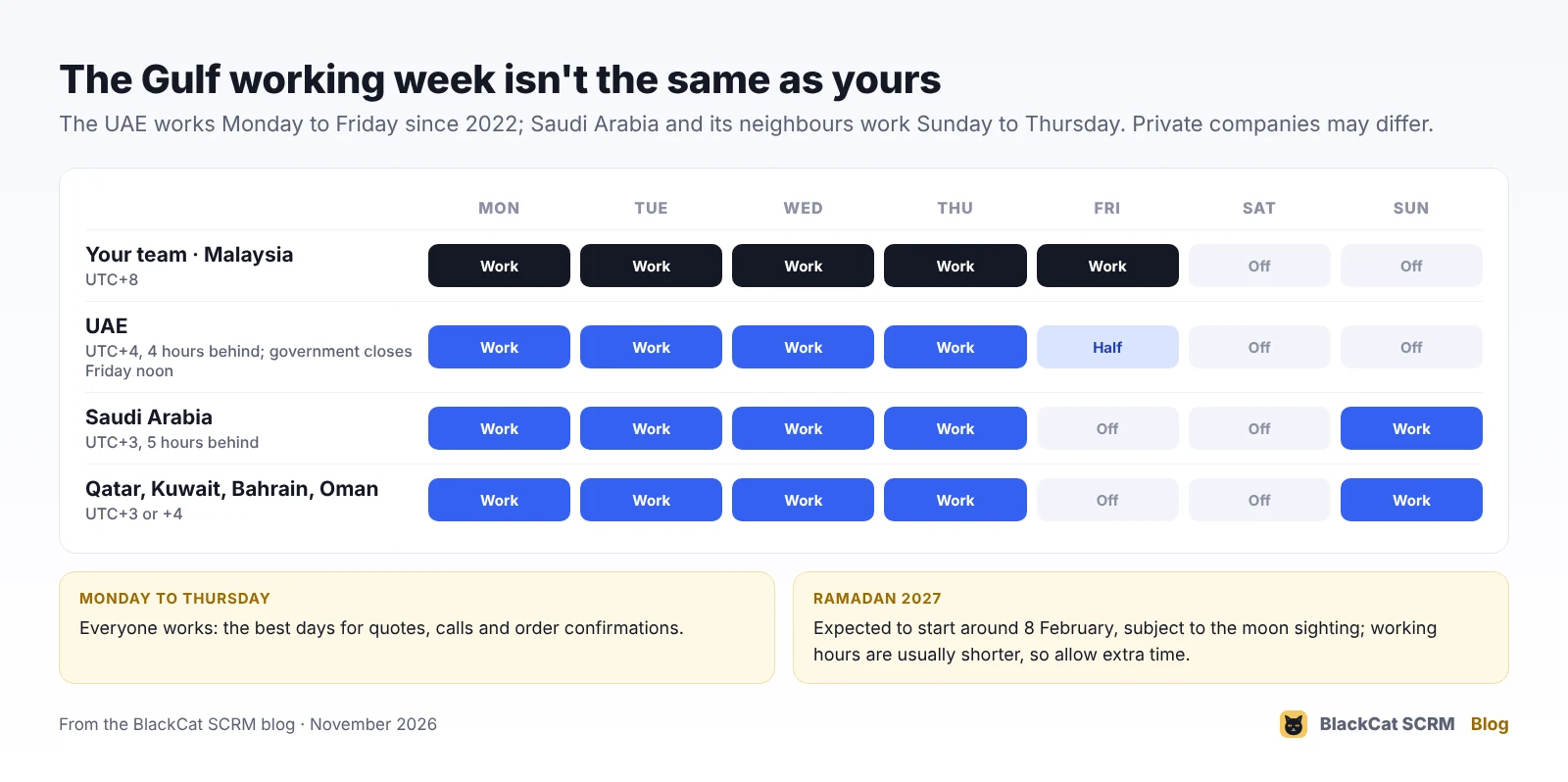
- Saudi Arabia moved its weekend to Friday and Saturday in June 2013, so the working week runs Sunday to Thursday. Qatar, Kuwait, Bahrain and Oman follow the same pattern.
- The UAE switched to a Monday-to-Friday week on 1 January 2022. Federal government offices close at noon on Friday; private companies chose their own arrangement, and most now work Monday to Friday.
- Time difference: the UAE (UTC+4) is four hours behind Malaysia, and Saudi Arabia (UTC+3) five. A buyer working until 6pm in Riyadh is messaging you at 11pm.
In practice: send quotes and book calls Monday to Thursday, expect Sunday enquiries from Saudi buyers, and don't read a quiet Friday afternoon from Dubai as a lost deal.
How should we plan around Ramadan and Eid?
Ramadan 2027 (1448 AH) is expected to begin around 8 February 2027 and end around 8 March, with Eid al-Fitr on about 9 March; the exact dates are confirmed only after the new moon is sighted, and can differ by a day between countries. During Ramadan, working hours are usually shorter and many people are active later in the evening.
- Confirm orders and artwork before Ramadan if the goods must arrive before Eid, a busy buying season for many retailers.
- Expect slower answers during the day and more activity after sunset; adjust your follow-up timing rather than sending more messages.
- A short seasonal greeting is welcome from a supplier the buyer already deals with. Keep it personal and brief, not a promotion.
Arabic or English?
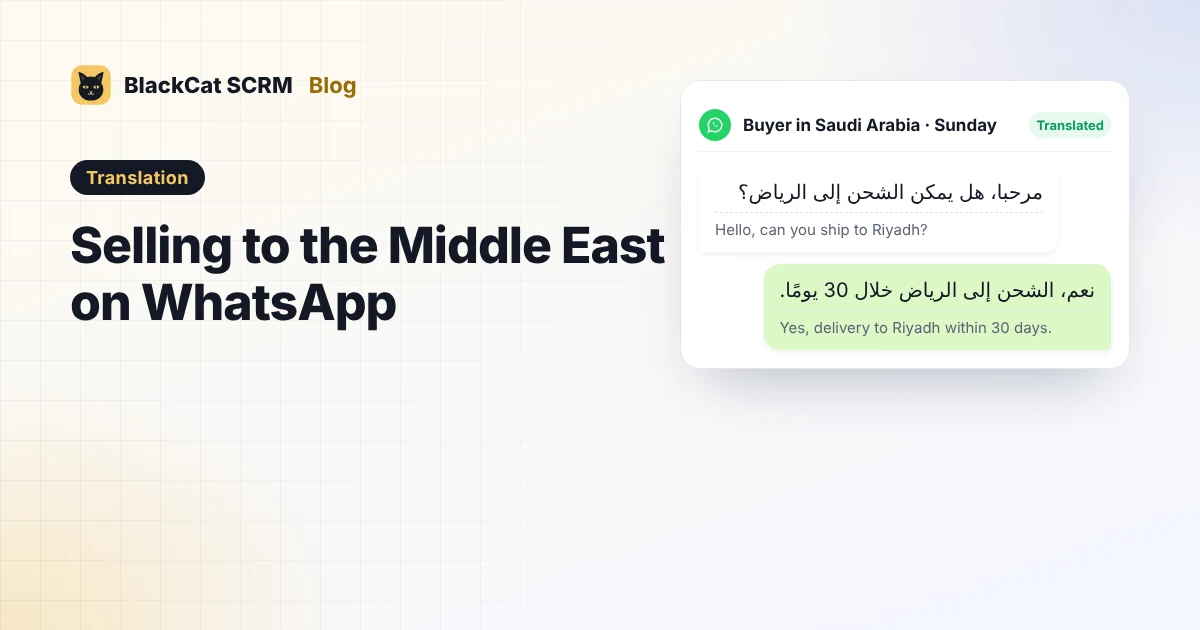
Answer in the language the buyer writes in. Many business buyers in the Gulf write in English, especially with foreign suppliers; others prefer Arabic.
- Arabic reads right to left, and mixed Arabic-English messages can look jumbled on screen. Keep product codes, prices and dates on their own lines.
- Figures: Arabic text may use Eastern Arabic numerals (٤٫٢٠ instead of 4.20). Write prices as numerals with a currency code, such as USD 4.20 or SAR 15.75, and check them after translation.
- Names and titles: use the name the buyer signs with. Don't guess titles or religion from a name; if the buyer greets you a certain way, it's natural to reply in kind.
What tone works on chat?
- Relationship first. A short greeting and a question about their business before the price list is normal, not wasted time.
- Voice notes and calls are common with some buyers; if you can't listen, transcribe them to text, ask politely for text, or reply in text with a short summary.
- Be ready to negotiate. Know your limits before the chat starts, and say clearly what a lower price depends on, such as quantity or payment terms.
- Be patient but specific. Follow up with something useful rather than "any update?", as in our guide to following up quiet buyers.
How does BlackCat SCRM help with Gulf buyers?
In BlackCat SCRM:
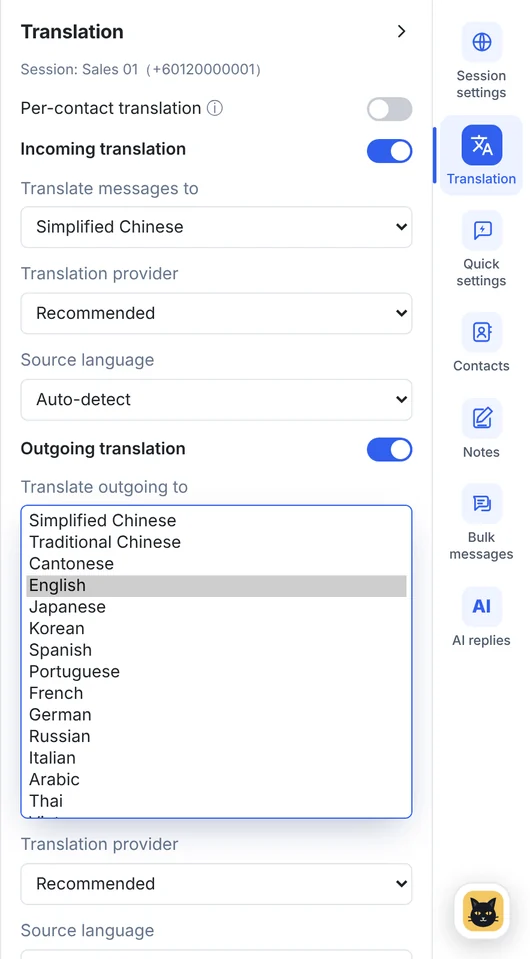
- Translation in 65 languages, including Arabic, both ways, per account or per customer, so you can answer Arabic-speaking buyers in Arabic and English-speaking ones in English.
- The translation shortcut (Ctrl+T by default) puts the Arabic in the typing box so you can check figures and names before pressing Enter.
- Quick replies for prices, MOQ, shipping and payment, set to translate first if you keep them in one language.
- AI replies (Pro and above) answer common questions from your knowledge base on Gulf evenings and Sundays, and hand over to a person when unsure.
- Voice messages: turn on voice transcription and click Transcribe or Translate under a buyer's Arabic voice note to read it in your language (WhatsApp, Telegram and Meta Business Suite).
- Customer notes for each buyer's preferred language, working days and what was quoted.
Honest limits: machine translation handles everyday sales Arabic, but check contracts, technical specifications and anything legal with a native speaker. AI replies only run while BlackCat is open and the computer is online.
Sources
- Crowell & Moring: Saudi Arabia changes weekend to Friday/Saturday from 29 June 2013.
- Khaleej Times: New UAE weekend and working hours in 2022; The National: UAE weekend change and the private sector.
- The National: Ramadan 2027 UAE dates and Eid al-Fitr holiday; Gulf News: When is Ramadan 2027?
- BlackCat SCRM user guide: translation, quick replies, AI replies and customer notes.
FAQ
What days do businesses work in Saudi Arabia?
Sunday to Thursday, with Friday and Saturday as the weekend, since 2013. Some private companies keep different hours.
Does the UAE work on Friday?
Yes. Since 2022 the UAE works Monday to Friday; federal government offices close at noon on Friday, and private companies set their own hours.
Should I reply to Gulf buyers in Arabic?
Reply in the language they write in. Many write in English; if they write in Arabic, an Arabic reply checked before sending shows care.
Can BlackCat translate Arabic chats?
Yes, in both directions, on WhatsApp, Telegram, LINE, Messenger and Meta Business Suite, per account or per customer.