Short answer: follow up three times over about two weeks, and make each message add something: a short question after 2–3 days, something useful around day 7 (photos, the lead time, a cheaper option), and around day 14 a polite “shall I put this on hold?” that makes “no” easy to say. Then stop and write down why. Keep messages short, in the buyer's language and working hours, and never write to someone who asked you to stop. BlackCat SCRM doesn't send reminders or scheduled messages, but it keeps each buyer's quote and next step in notes beside the chat, keeps your follow-ups as quick replies, translates them, and on Pro and above BlackCat Assistant can read the chat and suggest replies.
Why do buyers go quiet after a quote?
Silence after a quote is rarely a firm no. The usual reasons are more ordinary:
- They're comparing. Yours is one of three or four quotes, and they'll answer once they've lined them up.
- Someone else decides. Your contact passed it to a manager, a partner or their own customer.
- The timing moved. The project slipped, the budget waits for next month, or the season changed.
- Something in the quote stopped them. The price, the minimum order, the lead time, or a question they didn't think to ask.
- Your message got buried. A buyer who deals with many suppliers can have dozens of unread chats.
Research on business buying points the same way. In Gartner's research on B2B purchases, buyers spent only 17% of their buying time meeting potential suppliers, all of them together; a more recent Gartner guide puts it at 24%. The rest goes on their own research and on discussions inside their company. Most of the decision happens where you can't see it, so a quiet chat is normal, and a well-timed follow-up keeps you in the running.
How often should you follow up, and when do you stop?
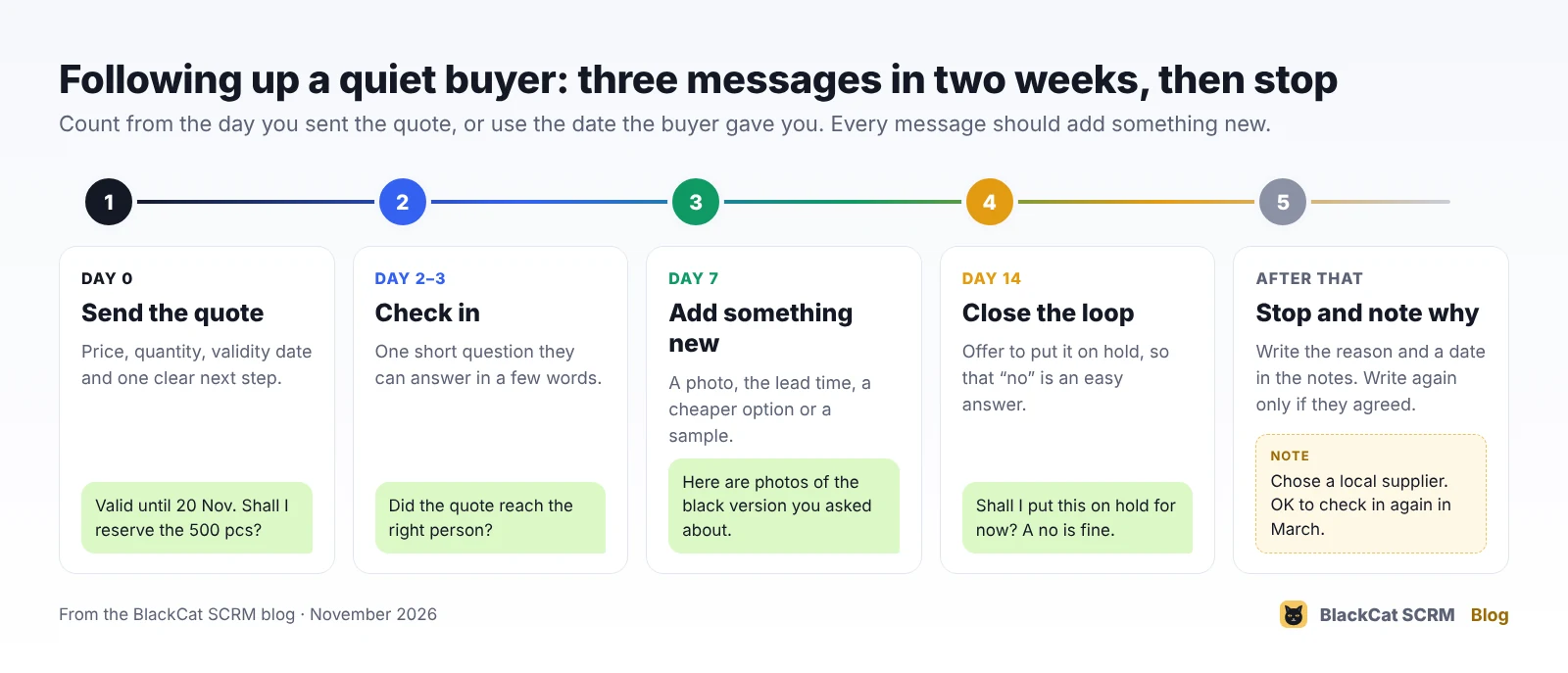
A plan that suits most quotes:
- Day 0, the quote. End it with one clear next step and a date, such as how long the price holds. A quote that ends with a question is easier to answer than one that just stops.
- Day 2–3, a short check-in. One question the buyer can answer in a few words.
- Day 7, something new. Real photos, an updated lead time, a cheaper alternative, a sample offer, or the answer to the question they probably have.
- Day 14, close the loop. Offer to put the quote on hold. Make “no” easy to say: “not now” is still an answer you can plan around.
- Then stop. Write the reason and the date in your notes. If they said “try me again in March”, that's your next follow-up. If not, leave it.
Is following up worth it at all? There's little public data on chat follow-ups. The best-known email study, in which Backlinko and Pitchbox analysed 12 million outreach emails, found that only 8.5% got a reply and that one follow-up raised replies by 65.8%. That was cold email, not a chat with a buyer who asked you for a price, but the lesson carries over: plenty of replies come after the first nudge. A chat message is more personal than an email and buzzes on the buyer's phone, so space your follow-ups out rather than squeezing more in.
What should each follow-up say?
Keep each message short enough to read in a notification, and make it about the buyer's decision, not about you waiting. Replace the [brackets] with real details when you save the message.
Day 2–3: check in
| EN | Hi [Name], did my quote for the [500] [product] reach the right person? Happy to adjust the quantity or delivery terms if that helps. |
|---|---|
| BM | Hai [Nama], adakah sebut harga untuk [500] [produk] sudah sampai kepada pihak yang berkenaan? Saya boleh ubah kuantiti atau terma penghantaran jika perlu. |
| 中文 | [称呼]您好,[500] 件[产品]的报价转给负责的同事了吗?如果数量或交货条件需要调整,跟我说一声就好。 |
Day 7: add something new
| EN | Hi [Name], here are real photos of the [black version] you asked about. Our lead time is currently [25] days, so an order confirmed this week would ship by [date]. |
|---|---|
| BM | Hai [Nama], ini gambar sebenar [versi hitam] yang anda tanyakan. Tempoh pengeluaran kami sekarang [25] hari, jadi pesanan yang disahkan minggu ini boleh dihantar sebelum [tarikh]. |
| 中文 | [称呼]您好,您之前问的[黑色款],实拍图发您看看。我们现在的交期是 [25] 天,这周确认的话,[日期]前可以发货。 |
Day 14: close the loop
| EN | Hi [Name], shall I put this quote on hold for now? If the price or timing isn't right, just say so, that's completely fine. I can check back later if you'd like. |
|---|---|
| BM | Hai [Nama], perlukah saya tangguhkan dulu sebut harga ini? Jika harga atau masanya kurang sesuai, beritahu saja, tiada masalah. Saya boleh hubungi semula kemudian jika anda mahu. |
| 中文 | [称呼]您好,这份报价要不要先放一放?如果价格或时间不合适,直接告诉我就好,没关系。需要的话,我过段时间再联系您。 |
After a “not now”
| EN | Thanks for letting me know, [Name]. I've made a note. Shall I check back in [March], or would you rather contact me when you're ready? |
|---|---|
| BM | Terima kasih kerana memaklumkan, [Nama]. Saya sudah catat. Boleh saya hubungi semula pada bulan [Mac], atau anda lebih suka hubungi saya apabila sudah bersedia? |
| 中文 | 谢谢告知,[称呼]。我记下了。[3 月]再跟您联系可以吗?还是您那边准备好了再找我? |
What makes a follow-up feel pushy?
- “Just following up” with nothing new. If you have nothing to add, wait until you do.
- Pointing at the blue ticks. “I can see you've read it” puts the buyer on the spot. Blue ticks only mean the message was read (and only when read receipts are on), not that a decision was made.
- Writing every day, or at night. Send during the buyer's working hours, in their time zone, a few days apart.
- Pressure that isn't true. “The price goes up tomorrow” works once, and only if it's real.
- Calling out of the blue. Unless the buyer usually phones you, ask by text before you call.
- The same nudge to everyone. A follow-up answers one conversation. Bulk messages are for customers who agreed to receive updates, not for chasing quotes.
Does WhatsApp limit how you follow up?
It depends on how you use WhatsApp:
- On the WhatsApp Business Platform (the API), a customer's message opens a 24-hour customer service window. After that, you can only send pre-approved template messages, so a free-form “any news?” a week later isn't possible.
- In the WhatsApp app and the WhatsApp Business app there's no 24-hour window, but WhatsApp's rules still apply. Its Business Messaging Policy says to contact people only if they gave you their number and agreed to hear from you, and to respect any request to stop, made on or off WhatsApp. People can block or report you, and WhatsApp may limit how many messages a business can send based on that feedback.
A buyer who asked you for a quote expects a follow-up about that quote. That's not the same as adding them to your promotions. If someone says “no thanks” or “please stop”, stop, note it, and don't write again.
How does BlackCat SCRM help, and what doesn't it do?
Follow-ups usually go wrong because someone forgot what was quoted or when to write. In BlackCat SCRM:
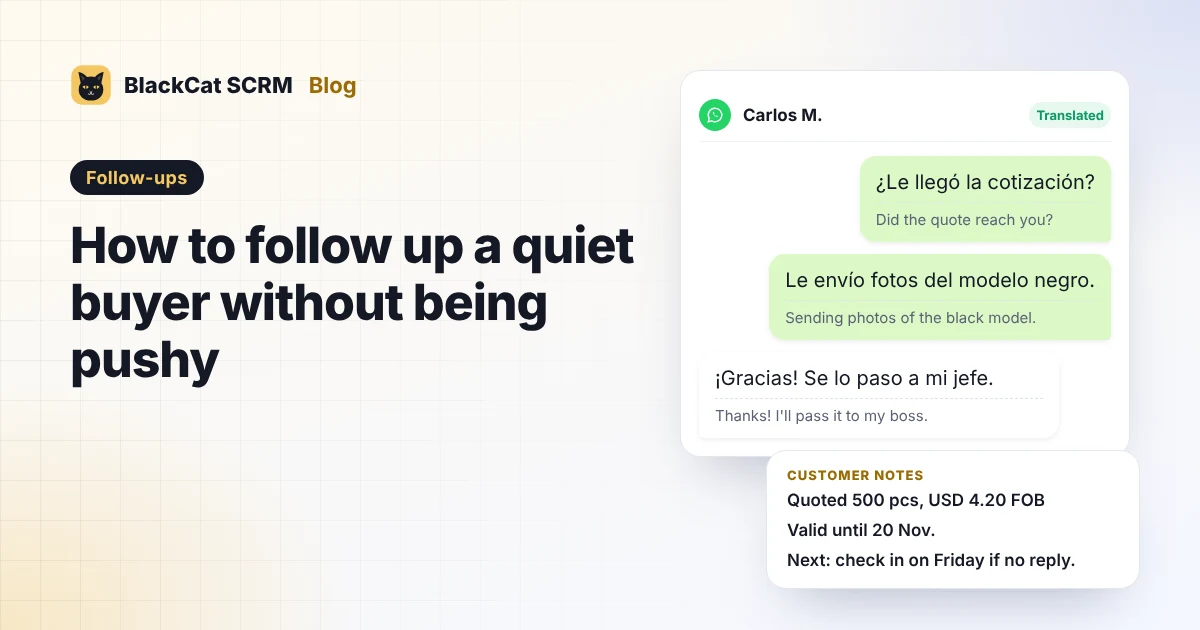
- Customer notes sit beside each chat and change with the customer. Write what you quoted, how long the price holds and the next step with its date, so whoever opens the chat knows where it stands. On WhatsApp, Telegram and Messenger you can right-click the quote message or file and choose Save to notes.
- Quick replies keep your follow-up messages, personal or shared with the team, ready to send with one click.
- Translation in 65 languages sends them in the buyer's language. Set quick replies to translate first, so one saved version works for every market.
- BlackCat Assistant (Pro and above) reads the chat and suggests 2–3 replies; one click puts the one you like in the typing box. You can also ask it to add a line to a customer's notes. Anything that sends a message waits for you to confirm.
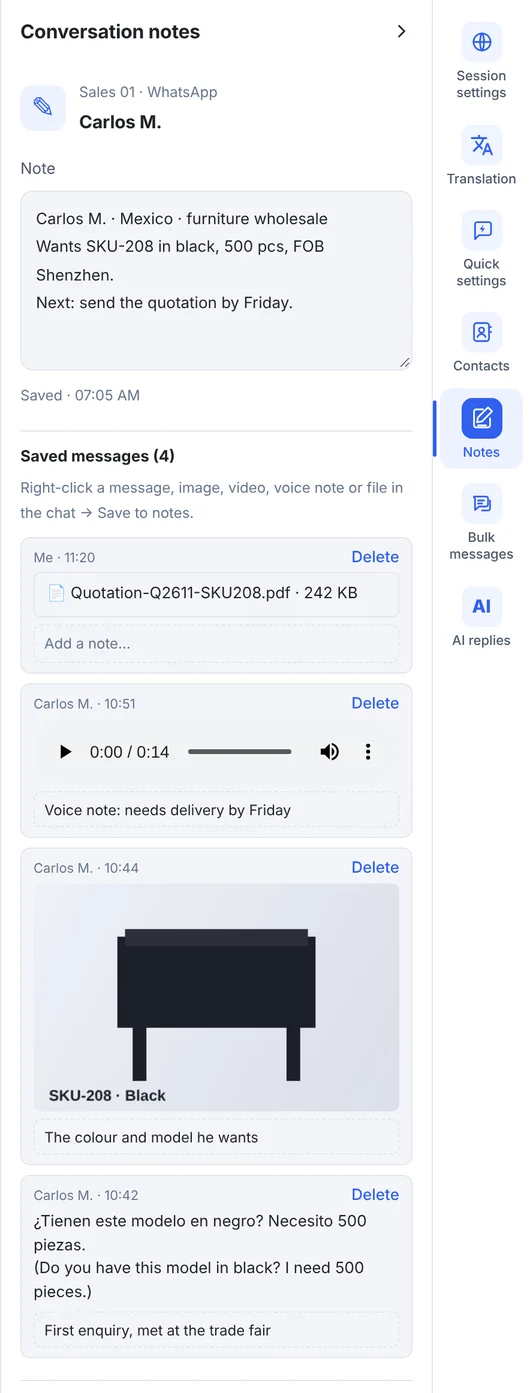
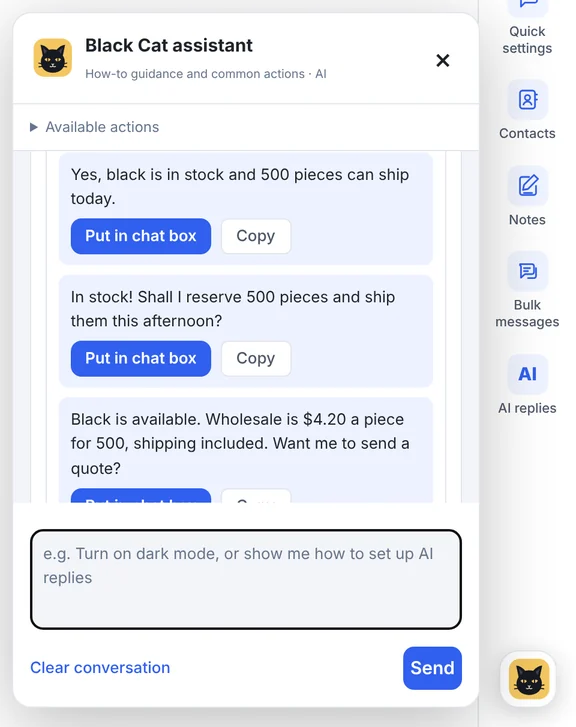
Honest limits: BlackCat has no reminders, no scheduled messages and no automatic follow-up sequences. AI replies only answer new messages from customers; they never start a follow-up. Keep the dates in your notes and in your own calendar or task list. Typed notes sync across computers on the Business and Enterprise plans.
Sources
- WhatsApp: WhatsApp Business Messaging Policy (opt-in, respecting requests to stop, limits based on user feedback).
- WhatsApp: Terms for the WhatsApp Business app (honouring requests to stop receiving messages).
- Meta for Developers: Service messages and the customer service window.
- WhatsApp Help Center: How to check read receipts.
- Backlinko: We analyzed 12 million outreach emails (with Pitchbox; cold email outreach, not chat).
- Gartner: The B2B buying journey (17% of buying time with suppliers) and Reinvent your commercial strategy (24%).
- BlackCat SCRM user guide: customer notes, Save to notes, quick replies and BlackCat Assistant.
FAQ
How long should I wait before following up?
Two to three working days after a quote is a good default. If the buyer told you when they'd decide, wait until that day and follow up then.
The buyer read my message but didn't reply. Should I mention it?
No. Blue ticks only show the message was read, not that a decision was made. Follow up with something useful instead, such as photos, a lead time or an alternative.
Can BlackCat SCRM remind me or send follow-ups automatically?
No. It has no reminders or scheduled messages, and AI replies only answer customers who write to you. Use notes for the next step and its date, quick replies for the messages, and your own calendar for the reminder.
Can I write to a quiet buyer again months later?
If they said you could, yes, at the time they suggested. If they said no or asked you to stop, don't. WhatsApp's Business Messaging Policy requires businesses to respect requests to stop.